
Posted by Ecommersify Editorial on Sep 26th 2026
Maple Drying Racks: Folding, Radial or Wall-Mounted?
A clothes drying rack needs to fit twice: once with laundry on it, and again when it is put away. Folding floor racks, radial arm designs and wall-mounted racks solve those two problems differently. Choose the format around the garments you actually air-dry and the space available to use it.
Begin with the clothes drying rack collection and compare each model in its fully open and stored positions.
A folding floor rack needs working room
The base footprint is only part of the occupied space. Sleeves, towels and longer garments can extend beyond it. Mark the open size in the place you intend to use the rack, then check doors and the route through the room.
Follow the model’s loading and operating instructions. Plan to distribute wet laundry as directed and keep the folding mechanism clear while opening or closing it.
A radial rack spreads garments around a center
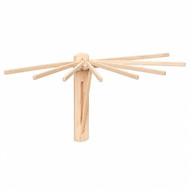
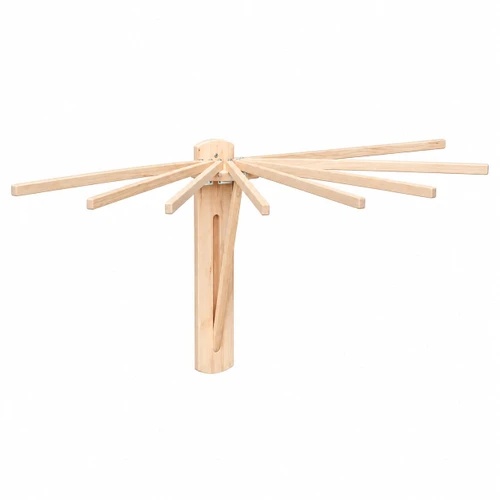
An arm-style rack can create useful hanging space around a central point. Compare arm length, the space between garments and how the arms fold. The open arrangement can be wider than its compact center suggests.
Think about the items you hang most often. Shirts on hangers, small pieces and longer fabric each occupy the rack differently. Arm count alone does not tell you how your regular load will fit.
A wall-mounted rack trades floor space for projection
A wall-mounted design can free the floor, but it still projects into the room when open. Measure that projection and the folded depth. Check cabinet doors, appliance access and the space taken by wet garments.
The rack, wall construction, mounting hardware and load need to work together. Follow the maker’s installation instructions and use an appropriate installer when the support requirements are uncertain.
Make airflow and loading practical
Leave the spacing called for by the product and the garments’ care needs. A crowded rack can make loading awkward and restrict air movement around fabric. Compare the layout with one actual laundry load rather than a theoretical maximum.
Clothespins and drying hangers can help organize suitable items, provided they are used within their own limits and those of the rack.
Decide where the rack lives between uses
Measure the stored dimensions and the intended storage location. Check whether a folding model stands, hangs or needs another arrangement. Let the wood dry as instructed before storing it, and ask before applying a coating that could affect the surface or transfer to clothing.
Choose from a real laundry day
Write down your regular air-dry items, available working area and storage place. Add the model’s stated loading and mounting requirements. The best rack is the one that serves that routine without taking over the room.
Explore Laundry & Home for the format that fits your space, or ask us about a specific model when a measurement needs clarification.